
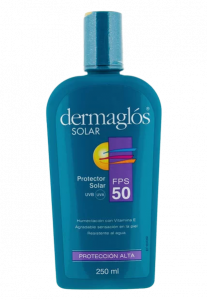
DERMAGLOS PROTECTOR SOLAR con FPS 50
6.6
Ingredientes
Water
Ingrediente generalmente considerado seguro para su uso en productos de Belleza y Cuidado Personal.
Homosalate
Ingrediente potencialmente tóxico a nivel de desarrollo y reproducción (bajo evaluación por la comunidad científica. Es absorbido por la piel y se ha detectado su presencia en la leche materna.
Benzophenone-3
Ingrediente potencialmente fotoalergénico. Su uso en productos de Cosmética y Cuidado Personal esta restringido en ciertos países como Japón.
Butyl Methoxydibenzoylmethane
Ingrediente potencialmente irritante y sensibilizador de la piel. Otros riesgos potenciales se encuentran en proceso de evaluación. Su uso en productos de Belleza y Cuidado Personal está sujeto a limitaciones de concentración y restricciones de manufactura.
Ethylhexyl Methoxycinnamate
Ingrediente potencialmente perturbador del sistema endócrino y fotoalergénico.
Ethylhexyl Salicylate
Existen restricciones en cuanto a la concentración máxima permitida y el tipo de formulaciones en los que puede utilizarse este ingrediente. Potencialmente tóxico para el ambiente.
Propylene Glycol
Existen restricciones en cuanto a la concentración máxima permitida y el tipo de formulaciones en los que puede utilizarse este ingrediente. Potencialmente irritante y sensibilizador de pieles sensibles.
Potassium Cetyl Phosphate
Ingrediente potencialmente irritante para la piel.
Titanium Dioxide
Existen restricciones en cuanto a la concentración máxima permitida y el tipo de formulaciones en los que puede utilizarse este ingrediente. Potencialmente irritante y sensibilizador de la piel.
Stearic Acid
Ingrediente generalmente considerado seguro para su uso en productos de Belleza y Cuidado Personal, en las condiciones actuales de concentración y prácticas de uso.
Alumina
Ingrediente potencialmente tóxico, sensibilizador de la piel, cancerígeno y peligroso para el ambiente.
Acrylates/Steareth-20 Methacrylate Copolymer
Ingrediente generalmente considerado seguro para su uso en productos de Belleza y Cuidado Personal. Sin embargo, estos polímeros (o microplásticos) han mostrado efectos adversos sobre el ambiente y la vida acuática.
Cetyl Alcohol
Ingrediente generalmente considerado seguro para su uso en productos de Belleza y Cuidado Personal, en las condiciones actuales de concentración y prácticas de uso.
Tocopheryl Acetate
Ingrediente generalmente considerado seguro para su uso en productos de Belleza y Cuidado Personal. Es un derivado sintético de la vitamina E, en su forma de acetato y posee propiedades antioxidantes.
Imidazolidinyl Urea
-
Xanthan Gum
Ingrediente generalmente considerado seguro para su uso en productos de Belleza y Cuidado Personal.
PEG-2 Stearate
Ingrediente potencialmente irritante para la piel y peligroso para la vida acuática.
Allantoin
Posee la capacidad de eliminar tejido necrótico en casos de úlceras en la piel y puede promover la proliferación celular y la cicatrización de la piel.
Methylparaben
Ingrediente (parabeno) potencialmente estrogénico (en proceso de evaluación).
Disodium EDTA
Ingrediente generalmente considerado seguro para su uso en productos de Belleza y Cuidado Personal. Sin embargo, es potencialmente bioacumulable y peligroso para el ambiente.
Tocopherol
Ingrediente generalmente considerado seguro para su uso en productos de Belleza y Cuidado Personal.
Propylparaben
Ingrediente (parabeno) potencialmente tóxico a nivel reproductivo, perturbador endocrino,.
Fragrance
El contacto directo con ciertas fragancias o aromas sintétocos inespecíficos puede ocasionar alergias, irritar o sensibilizar la piel.
Sodium Hydroxide
Ingrediente generalmente considerado seguro para su uso en productos de Belleza y Cuidado Personal, en las condiciones actuales de concentración y prácticas de uso.
Más información
El análisis de ingredientes ha sido elaborado por investigadores del CONICET (*) en base a las siguientes referencias bibliográficas:
- http://www.safecosmetics.org/get-the-facts/chemicals-of-concern/homosalate/. Insufficient data to make a “generally recognized as safe and effective†(US Food and Drug Administration (FDA). Sunscreen drug products for over-the-counter human use: proposed rule. Fed Regist. 2019
- 84(38):6204-6275. https://www.govinfo.gov/content/pkg/FR-2019-2-26/pdf/2019-3019.pdf. Accessed April 1, 2019).
- European Commission Legislation (Regulation (EC) N° 1223/2009 y 2019/831, Annexes I to VI and all the amendments to the cosmetics regulation).
- California Department of Public Health - California Safe Cosmetics Program, August 2016.
- SCCP (2006) Opinion on Benzophenone-3. European Commission - The Scientific Committee on Cosmetic Products and Non-Food Products Intended for Consumers. SCCP/1069/06 Retrieved from http://ec.europa.eu/health/ph_risk/committees/04_sccp/sccp_opinions_en.htm.
- US Food and Drug Administration (FDA)
- EU (European Union)- Strategy for Endocrine Disrupters 2007. Commision on endocrin disruption requested by the European Parliament in 1998.
- EC (Environment Canada). 2008. Domestic Substances List Categorization. Canadian Environmental Protection Act (CEPA) Environmental Registry.
- CIR (Cosmetic Ingredient Review). CIR Compendium, containing abstracts, discussions, and conclusions of CIR cosmetic ingredient safety assessments (Washington DC, 2006).
- Final Report on the Safety Assessment of Propylene Glycol and Polypropylene Glycols. (1994). Journal of the American College of Toxicology, 13(6), 437–491.
- US - FOOD & DRUG Administration (FDA). Generally Recognized as Safe (GRAS) Substances (SCOGS) Database (SCOGS Number 27,1973. Conclusion 1)
- European Chemical Agency (ECHA)
- American Society of Health-System Pharmacists 2013
- Drug Information 2013. Bethesda, MD. 2013
- SCCNFP/0005/98 (Scientific Committee on Cosmetic Products and Non-Food Products) Titanium Dioxide, adopted by the SCCNFP (2000). More information available online: http://ec.europa.eu/health/scientific_committees/consumer_safety/docs/sccs_o_136.pdf
- International Standards Organization (1995). Air Quality Particle Size Fraction Definitions for Health-related Sampling. (ISO Standard 7708), Geneva.
- Health and Safety Executive (2000). General Methods for Sampling and Gravimetric Analysis of Respirable and Inhalable Dust: Methods for the Determination of Hazardous Substances: MDHS 14/3. London.
- IARC: International Agency for Research on Cancer. IARC Monographs Volume 93. Titanium Dioxide. Pg. 199. Available online: https://monographs.iarc.fr/ENG/Monographs/vol93/mono93-7.pdf
- Moran CA et al. Hum Pathol 22 (5): 450-4 (1991)
- Pimentel JC. Acta Med Port 5 (6): 307-13 (1992)
- Rode LE et al. Acta Pathol Microbiol Scand A 89 (6): 455-61 (1981)
- Yamadori I et al. Acta Pathol Jpn 36 (5): 783-90 (1986)
- Fryzek JP et al. J Occup Environ Med 45 (4): 400-9 (2003)
- Churg A et al. Am J Physiol 277 (5 Pt 1): L975-82 (1999)
- Donaldson K et al. Inst Occupat Med Edinburgh Report No TM/88/01 (1988)
- https://www.cdhfinechemical.com/images/product/msds/110_1478813374_TitaniumDioxide-CASNO-13463-67-7-MSDS.pdf
- Aruoja V et al. Sci Total Environ 407 (4): 1461-1468 (2009)
- Heinlaan M et al. Chemosphere 71 (7): 1308-1316 (2008)
- Wiench K et al. Chemosphere 76 (10): 1356-65 (2009)
- Griffitt RJ et al. Environ Toxicol Chem 27 (9): 1972-78 (2008)
- CIR (Cosmetic Ingredient Review). 2006. CIR Compendium, containing abstracts, discussions, and conclusions of CIR cosmetic ingredient safety assessments. Washington DC.
- Domestic Substances List Categorization. Canadian Environmental Protection Act (CEPA) (2008).
- EPA (U.S. Environmental Protection Agency). 1999. Toxics Release Inventory Program. PBT Chemical Rule.
- CIR (Cosmetic Ingredient Review). Safety Assessment of Acrylates Copolymers as Used in Cosmetics (2018).
- Rillig, M. C., et al. (2019). Microplastic effects on plants. New Phytologist, 223(3), 1066-1070.
- Sussarellu, R., et al. (2016). Oyster reproduction is affected by exposure to polystyrene microplastics. Proceedings of the National Academy of Sciences, 113(9), 2430-2435.
- CowanEllsberry, C.E., Dyer, S.D., Erhardt, S., Bernhard, M.J., Roe, A.L., Dowty, M.E., Weisbrod, A.V., 2008. Approach for extrapolating in vitro metabolism data to refine bioconcentration factor estimates. Chemosphere 70, 180-1817. Dyer, S.D., Bernhard, M.J., CowanEllsberry, C., Perdu-Durand, E., Demmerle, S., Cravedi, J.-P., 2008. In vitro biotransformation of surfactants in fish. Part I: Linear alkylbenzene sulfonate (C12-LAS) and alcohol ethoxylate (C13EO8). Chemosphere 72, 850-862. Peter Fisk Associates Limited (2012) Position paper: Bioaccumulation of Aliphatic Alcohols in the context of REACH registration. Reference: PFA.197.18.02. Date: 10 August 2012.
- Manca, M. L., et al. (2016). Combination of argan oil and phospholipids for the development of an effective liposome-like formulation able to improve skin hydration and allantoin dermal delivery. International Journal of Pharmaceutics. In Press. DOI: http://dx.doi.org/doi:10.1016/j.ijpharm.2016.4.08
- Becker LC, Bergfeld WF, Belsito DV, et al. Final report of the safety assessment of allantoin and its related complexes. Int J Toxicol. 2010
- 29(3 Suppl):84S-97S. doi:10.1177/1091581810362805
- Lanigan RS, Yamarik TA. Int J Toxicol. 2002, 21 Suppl 2:95‐142.
- Orenstein, A., Kostenich, G., Tsur, H., Roitman, L., Ehrenberg, B., & Malik, Z. (1995) in Photodynamic therapy of cancer II (Vol. 2325, pp. 100-105). International Society for Optics and Photonics.
- SCCNFP (The Scientific Committee on Cosmetic Products and Non-Food Products Intended for Consumers) 1999. Opinion concerning fragrance allergy in consumers. A review of the problem. Analysis of the need for appropriate consumer information and identification of consumer allergens. SCCNFP/0017/98 Final. December 199 - Tatyana Hamilton and Gillian C de Gannes. 2011. Allergic contact dermatitis to preservatives and fragrances in cosmetics. Skin therapy letter 16(4), 1-4 .- Anne Birgitte Simonsen, Mette Deleuran, Jeanne Duus Johansen and Mette Sommerlund 2011. Contact allergy and allergic contact dermatitis in children - a review of current data. Contact dermatitis 65(5), 254-65.
- US - FOOD & DRUG Administration (FDA). Generally Recognized as Safe (GRAS) Substances (SCOGS) Database (SCOGS Number 85,1976. Conclusion 1)
(*) Según el ranking SCImago 2020, el CONICET alcanza la segunda posición entre las instituciones académicas y de investigación más prestigiosas de América Latina. A nivel mundial, ocupa la posición 230 entre 7000 instituciones privadas y gubernamentales.