

Familand Jabón Castaña
6.1
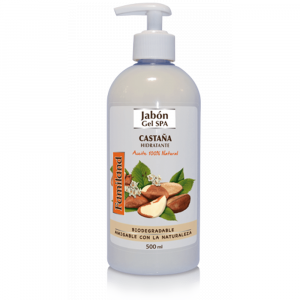
Ingredientes
GLYCERIN
Ingrediente generalmente considerado seguro para su uso en productos de Belleza y Cuidado Personal.
BERTHOLLETIA EXCELSA SEED OIL
Ingrediente generalmente considerado seguro para su uso en productos de Belleza y Cuidado Personal.
AQUA
Ingrediente generalmente considerado seguro para su uso en productos de Belleza y Cuidado Personal.
SODIUM LAURETH SULFATE
Ingrediente generalmente considerado seguro para su uso en productos de Belleza y Cuidado Personal, en las prácticas actuales de uso y concentración.
LAURAMIDOPROPYL BETAINE
-
COCAMIDE MEA
Ingrediente aprobado para su uso en productos de Belleza y Cuidado Personal, sujeto a restricciones y limitaciones de concentración y uso. Ingrediente potencialmente irritante para la piel y tóxico para el ambiente.
STYRENE/ACRYLATES COPOLYMER
Ingrediente (microplástico) potencialmente peligroso para el ambiente.
SODIUM CHLORIDE
Ingrediente generalmente considerado seguro para su uso en productos de Belleza y Cuidado Personal, en las condiciones actuales de concentración y prácticas de uso.
PARFUM
El contacto directo con ciertas fragancias o aromas sintétocos inespecíficos puede ocasionar alergias, irritar o sensibilizar la piel.
ACRYLATES COPOLYMER
Ingrediente (microplástico) potencialmente peligroso para el ambiente.
TETRASODIUM EDTA
Ingrediente generalmente considerado seguro para su uso en productos de Belleza y Cuidado Personal, en las condiciones actuales de concentración y prácticas de uso. Sin embargo, la sobreexposición a este ingrediente puede resultar tóxica.
PEG-60-HYDROGENATED CASTOR OIL
Ingrediente generalmente considerado seguro para su uso en productos de Belleza y Cuidado Personal, en las condiciones actuales de concentración y prácticas de uso.
CITRIC ACID
Ingrediente generalmente considerado seguro para su uso en productos de Belleza y Cuidado Personal, en las condiciones actuales de concentración y prácticas de uso.
GUAR HYDROXYPROPYLTRIMONIUM CHLORIDE
Ingrediente generalmente considerado seguro para su uso en productos de Belleza y Cuidado Personal.
PEG-120 METHYL GLUCOSE DIOLEATE
-
SODIUM HYDROXIDE
Ingrediente generalmente considerado seguro para su uso en productos de Belleza y Cuidado Personal, en las condiciones actuales de concentración y prácticas de uso.
METHYLCHLOROISOTHIAZOLINONE
Ingrediente potencialmente cancerígeno, irritante para la piel, peligroso para la vida acuática, con efectos duraderos en el ambiente y con capacidad de alterar la información genética de un organismo biológico.
METHYLISOTHIAZOLINONE
Ingrediente potencialmente cancerígeno, sensibilizador de la piel, peligroso para la vida acuática y con efectos duraderos en el ambiente.
Más información
Extractos 100% naturales. Sin colorantes. Sin parabenos. Hipoalergénico dermatológicamente testeado producto biodegradable amigable con la naturaleza. Cruelty Free.
El análisis de ingredientes ha sido elaborado por investigadores del CONICET (*) en base a las siguientes referencias bibliográficas:
- Material Safety Data Sheet MSDS# 96129
- European Chemical Agency (ECHA)
- Loffler, H., and Happle, R. (2003). Profile of irritant patch testing with detergents: sodium lauryl sulfate, sodium laureth sulfate and alkyl polyglucoside. Contact Dermatitis, 48(1), 26-32.
- Andersen, F. Alan. “Final Report on the Safety Assessment of Cocamide MEA.” International Journal of Toxicology 18, no. 2_suppl (March 1999): 9–16.
- US - FOOD & DRUG Administration (FDA). Generally Recognized as Safe (GRAS) Substances (SCOGS) Database (SCOGS Number 102,1979. Conclusion 1 (dry food packaging), 4 (direct additive)
- SCCNFP (The Scientific Committee on Cosmetic Products and Non-Food Products Intended for Consumers) 1999. Opinion concerning fragrance allergy in consumers. A review of the problem. Analysis of the need for appropriate consumer information and identification of consumer allergens. SCCNFP/0017/98 Final. December 199 - Tatyana Hamilton and Gillian C de Gannes. 2011. Allergic contact dermatitis to preservatives and fragrances in cosmetics. Skin therapy letter 16(4), 1-4 .- Anne Birgitte Simonsen, Mette Deleuran, Jeanne Duus Johansen and Mette Sommerlund 2011. Contact allergy and allergic contact dermatitis in children - a review of current data. Contact dermatitis 65(5), 254-65.
- CIR (Cosmetic Ingredient Review). Safety Assessment of Acrylates Copolymers as Used in Cosmetics (2018).
- Rillig, M. C., et al. (2019). Microplastic effects on plants. New Phytologist, 223(3), 1066-1070.
- Sussarellu, R., et al. (2016). Oyster reproduction is affected by exposure to polystyrene microplastics. Proceedings of the National Academy of Sciences, 113(9), 2430-2435.
- Lanigan RS, Yamarik TA. Final report on the safety assessment of EDTA, calcium disodium EDTA, diammonium EDTA, dipotassium EDTA, disodium EDTA, TEA-EDTA, tetrasodium EDTA, tripotassium EDTA, trisodium EDTA, HEDTA, and trisodium HEDTA. Int J Toxicol. 2002
- 21 Suppl 2:95-142.
- CIR (Cosmetic Ingredient Review). CIR Compendium, containing abstracts, discussions, and conclusions of CIR cosmetic ingredient safety assessments (Washington DC, 2006).
- US - FOOD & DRUG Administration (FDA). Generally Recognized as Safe (GRAS) Substances (SCOGS) Database (SCOGS Number 84,1977. Conclusion 1)
- List of Safe and/or Natural Ingredients
- US - FOOD & DRUG Administration (FDA). Generally Recognized as Safe (GRAS) Substances (SCOGS) Database (SCOGS Number 85,1976. Conclusion 1)
- European Commission Legislation (Regulation (EC) N° 1223/2009 y 2019/831, Annexes I to VI and all the amendments to the cosmetics regulation).
- Final Report on the Safety Assessment of Methylisothiazolinone and Methylchloroisothiazolinone. (1992). Journal of the American College of Toxicology, 11(1), 75-128.
(*) Según el ranking SCImago 2020, el CONICET alcanza la segunda posición entre las instituciones académicas y de investigación más prestigiosas de América Latina. A nivel mundial, ocupa la posición 230 entre 7000 instituciones privadas y gubernamentales.